
NanoGUNE inaugurates the Quantum Tower, a new European benchmark in quantum technologies
CIC nanoGUNE launches its new quantum hardware laboratories, equipped with a unique infrastructure for developing silicon-based quantum chips in collaboration with Quantum Motion. The new Quantum Tower consolidates the Basque Country as a major hub for quantum-technology development and positions the project as an important milestone in research, innovation, and technology transfer.

The President of the Basque Government, Imanol Pradales, has officially inaugurated CIC nanoGUNE’s Quantum Tower, a strategic infrastructure that strengthens the Basque Country's position as a European benchmark in quantum technologies. The opening ceremony was also attended by the Deputy-General of the Regional Government of Gipuzkoa, Eider Mendoza; the mayor of San Sebastian, Jon Insausti; the president of nanoGUNE, Javier Martínez-Ojinaga; the basque minister of Science, Universities and Innovation, and other representatives from principal institutions, research centers, and european quantum industry.
President Imanol Pradales has stated that nanoGUNE's position in nanoscience enables us to make significant progress in developing quantum computers using technology “Made in the Basque Country”. It is a bridge to the future. While there are no certainties, the prospects are promising, with potential applications including new medicines, cancer detection systems, more sustainable materials, cybersecurity, and natural disaster prediction." Pradales also stressed that 'it is a bridge to strategic sovereignty in a critical area in which we are highly dependent on the United States and China' and emphasised that 'it strengthens the Basque Country's ability to make its own decisions and participate alongside Europe in global technological races'.
The director of nanoGUNE, Jose M. Pitarke, opened the event highlighting that “the positioning and recognition achieved since the creation of the center in 2009 constitute the foundation on which we will be able to develop quantum hardware at nanoGUNE; we are going to develop quantum computers with our own technology,” he emphasized.
The Quantum Tower houses nanoGUNE’s quantum-hardware research group, led by Ikerbasque Research Profesor Fernando Gonzalez-Zalba. Pitarke explained that the group will work in close collaboration with scale-up company Quantum Motion, “a pioneer in the sector,” to develop silicon-based quantum computing devices, using the same silicon platforms that underpin the microprocessors found in our conventional computers, mobile phones, or vehicles. “The scale and ambition of this project are such that we decided to expand our facilities with the construction of the new tower, the Quantum Tower, which we are inaugurating today,” he added.
The Quantum Tower covers approximately 1,500 m2 distributed over seven floors, of which two have been fitted out in a first phase. These spaces host nanoGUNE's laboratories dedicated to quantum-hardware research, as well as office space for the subsidiary that Quantum Motion has established in Donostia / San Sebastian.
 One of the key components of the new facilities is the set of dilution refrigerators, capable of reaching temperatures close to absolute zero –around 10 millikelvin– even colder than outer space. At these extreme conditions, thermal noise can be drastically reduced, and quantum effects emerge to enable their measurement and control. “These refrigerators allow us to develop quantum computers which, at their core, will utilize our quantum chips manufactured using industrial semiconductor technology. Particularly, we will develop quantum processors based on silicon because of the large-scale integration capability of the technology, unlocking sufficient computing power to run quantum algorithms that will radically improve society” explained Gonzalez-Zalba during the visit to the new facilities. The researcher also highlighted that “silicon-based quantum technologies are particularly promising due to their scalability as they will allow leveraging the vast existing industrial infrastructure used for manufacturing classical electronics to build quantum computers.”
“The Deputy General of Gipuzkoa, Eider Mendoza, highlighted the scientific and research trajectory of CIC nanoGUNE, always “at the frontier of knowledge,” as demonstrated, in her view, by the inauguration of the Quantum Tower and the quantum hardware laboratories. “This is a major milestone toward the goal of developing quantum technologies as a driver of scientific and technological progress, economic and industrial competitiveness, and the creation of opportunities and advanced projects,” Mendoza stressed. She reaffirmed that, in a context of major transformations and global uncertainty, “the commitment to science and knowledge” is the path to providing society with ‘well‑being, security, and resilience.”
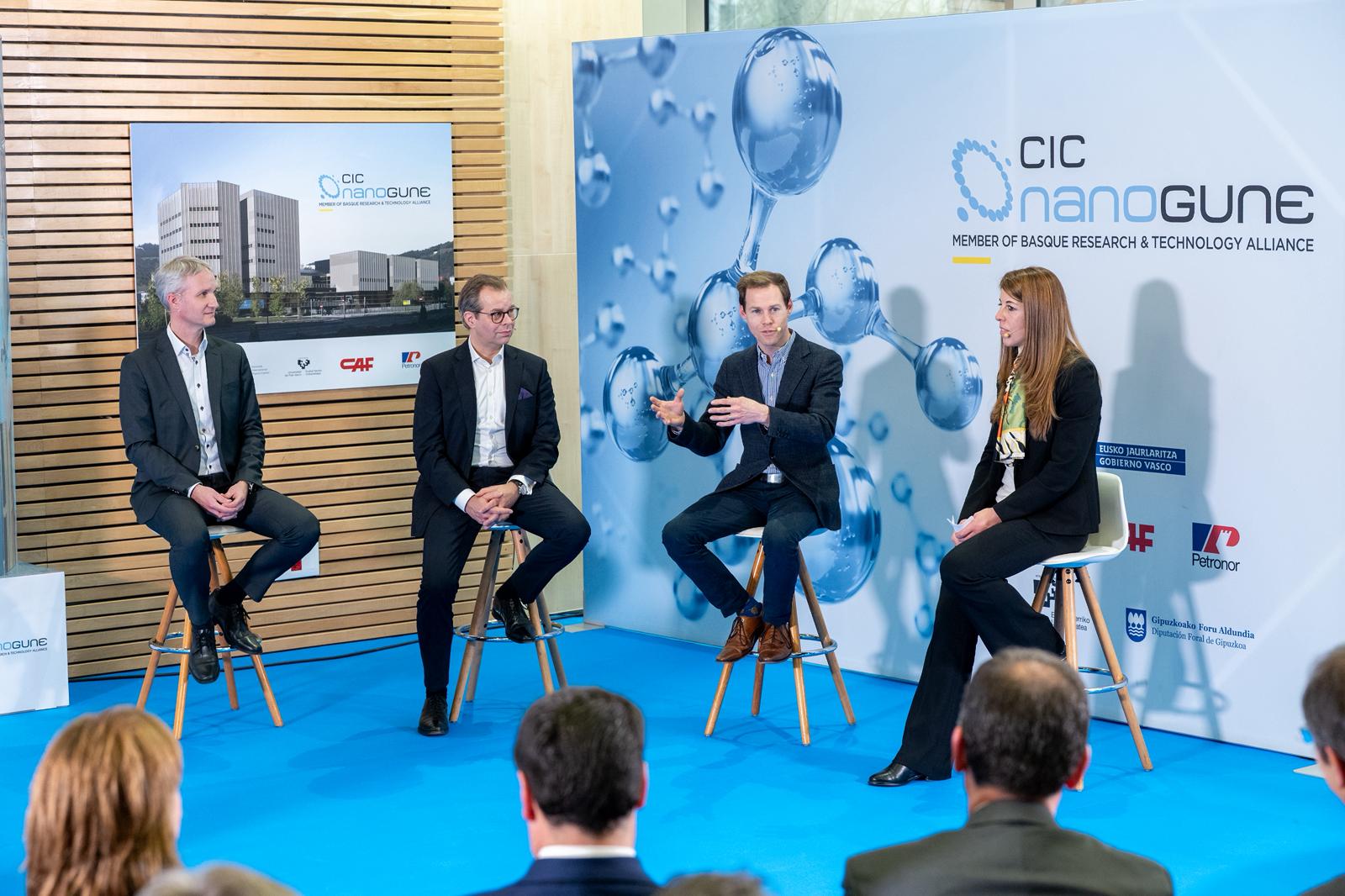
The opening ceremony also included a roundtable discussion featuring leading figures from the European quantum ecosystem. The participants addressed the challenges and opportunities of quantum technologies, as well as the role of large-scale research infrastructures –such as the Quantum Tower– within innovation ecosystems. The speakers were Oliver Hasse, Managing Director of INAM –Innovation Network for Advanced Materials–, Sebastian Luber, Director of Cybersecurity, Dependability, and Operations at Infineon Technologies, and James Palles-Dimmock, CEO of Quantum Motion Technologies.
“Our expansion in Europe demonstrates our continued commitment to global collaborations and partnerships,” said James Palles-Dimmock, CEO of Quantum Motion. “The state-of-the-art technology infrastructure available in the new Quantum Tower and our collaboration with the Basque government, academia and experts at CIC nanoGUNE provide a huge advantage as we advance our ability to deliver commercially useful, silicon-spin quantum systems at scale.”
About CIC nanoGUNE
The Nanoscience Cooperative Research Center (CIC) nanoGUNE, located in the Basque city of San Sebastian, was established with the mission of conducting world-class nanoscience research for the competitive growth of the Basque Country. NanoGUNE is recognized by the Spanish Research Agency as a Maria-de-Maeztu center of excellence.
About Quantum Motion
Quantum Motion develops and deploys full-stack quantum computers manufactured using industry standard 300mm CMOS wafer technology with the goal of delivering commercially viable, utility scale, fault tolerant systems. A key part of this approach is the development of cryoelectronics, integrating qubits with classical control circuits capable of operating at deep cryogenic temperatures, which enables extreme scaling of quantum processors. Fault-tolerant quantum computing will enable the most powerful quantum algorithms, targeting solutions to currently intractable problems in fields as diverse as chemistry, materials science, medicine and artificial intelligence. The company employs over 100 people across the UK, US, Australia and Europe and comprises specialists in quantum theory, hardware and system engineering and software.